Josefina Guerrero: The Leper Spy
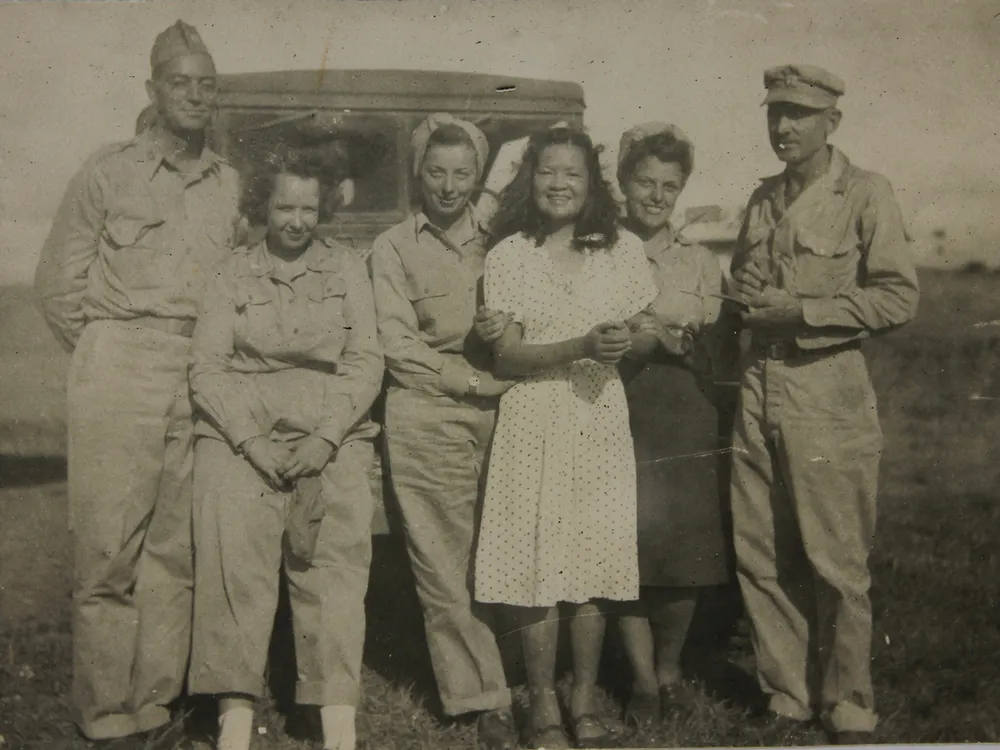
For two days in February 1945, a petite, sickly Filipina woman—her body marked by leprous lesions—moved furtively toward American troops’ position in Calumpit, around 30 miles north of Manila. She traveled first on foot, dodging Japanese soldiers, and then on a bangka boat on the Pampanga River, pursued by opportunistic river pirates who thrived in the chaos of war.
The United States Army’s 37th Infantry Division had decamped in Calumpit after landing in the Lingayen Gulf on January 9. Now, the soldiers were ready to launch their assault on Manila. But they didn’t know that the route they intended to take was laden with newly planted mines. They were rushing toward a death trap, and the only map warning them was in this woman’s possession.
So dangerous was the secret assignment that the devoutly religious spy’s handler advised her to “go to confession and make a good act of contrition” before setting out on her last-ditch gambit to deliver information that could save the men—a mission that proved successful.
For her bravery during this and many other perilous operations, Josefina “Joey” Guerrero was later credited by Major General George F. Moore with demonstrating “more courage than that of a soldier on the field of battle.”
Guerrero’s early life bore none of the hallmarks of a future spy. Born Josefina Veluya in the Philippines’ Quezon Province in 1917, she was orphaned at a young age and suffered through a bout of childhood tuberculosis. “I played that I was Joan of Arc, and that I heard voices,” she later recalled. Guerrero was fond of music and poetry and excelled in sports and extracurricular activities. In 1934, she married Renato Maria Guerrero, a medical student. They had a daughter, Cynthia, and settled into a promising, comfortable life in Manila.
By 1939, Europe was at war, and Asia was on the verge of its own cataclysmic conflict. Ominous symptoms started plaguing Guerrero—aches, fever and blotches she was increasingly unable to ignore or hide. A doctor delivered the shattering diagnosis of leprosy (now more commonly called Hansen’s disease), a condition that has been cruelly stigmatized for thousands of years. Fearing banishment to a grim leprosarium (a hospital for lepers), the family sought to quietly manage and conceal Guerrero’s condition—but it would ultimately tear them apart.
“It’s hard to imagine more jarring, traumatic circumstances in the course of one life span, starting with the realization [that] she’s got leprosy,” says Ben Montgomery, author of The Leper Spy: The Story of an Unlikely Hero of World War II. “At that point—especially in Manila—you’re done, you’re an outcast.”
Another calamity followed. Japan’s attack on Pearl Harbor on December 7, 1941, preceded a series of attacks on air bases in the Philippines, then a U.S. territory. In January 1942, the Japanese invaded the archipelago, clashing with Filipino and American troops led by General Douglas MacArthur.
The soldiers fought for three miserable months. MacArthur promised badly needed reinforcements, but they never materialized. Their rations depleted and their men starving, sick and wounded, the Allied forces surrendered on April 9, 1942. No rest was found even in the bitter relief of surrender; tens of thousands of Filipinos and hundreds of American soldiers were forced to walk to prisoner-of-war camps during the Bataan Death March, a 65-mile journey that claimed an estimated 10,000 lives, with men dying of hunger and exhaustion or at the ends of Japanese bayonets.
MacArthur famously vowed to return to the Philippines—but first, the war in the Pacific theater had to be fought.
From this defeat, a disorganized resistance emerged among Filipino guerrillas across remote areas of the sprawling archipelago. They established a small but vital trickle of intelligence to the new Allied Intelligence Bureau, passing information by courier, illicit radios and messages to remote submarines. The “hazardous labor” these individuals undertook, MacArthur said, gave his headquarters “precise, accurate and detailed information on major enemy moves and installations throughout the Philippine Archipelago” and paved the way for the Americans’ return.
Among these resisters’ ranks was Guerrero. In this moment of confluence between personal and national tragedy, she chose to use her misfortune to the Allies’ advantage. She wanted to aid her country, later saying, “It didn’t really matter whether I lived or died.”
Soon, Guerrero was closely observing the movement of Japanese troops near her home, mapping out Japanese fortifications along Manila Bay, sketching anti-aircraft guns and passing information on to guerrillas. The blotches from her leprosy—erroneously believed to be highly contagious—terrified enemy soldiers, allowing her to pass through checkpoints on her way to resistance strongholds with a more cursory search than the unafflicted.
Her tasks took many forms. When Guerrero attended a party at a nearby state university, she saw one of the Japanese soldiers who were using the school as a base duck into a large hole that supposedly led to an air raid shelter. After spotting the same man emerge elsewhere on campus, she realized the hole was part of a secret tunnel. On another occasion, Guerrero dutifully hid a truckload of spare “tires”—actually crude explosives—that were dropped off at her home in the middle of the night. Days later, guerrillas used these incendiaries to set fire to Japanese munition stores.
Serving in the resistance was a terrifying prospect in any theater of World War II. But conducting this type of espionage right under the watchful eye of Japanese occupiers carried risks of a different magnitude. “Guerrillas had a lot more flexibility out in the provinces … but in Manila, where you had a larger concentration of Japanese, it was very, very dangerous,” says James M. Scott, author of Rampage: MacArthur, Yamashita and the Battle of Manila.
If caught, Guerrero would likely have been subjected to gruesome interrogations that could have easily ended in death. The feared Kempeitai, or Japanese police, were “taking people that they suspected of being guerrillas … and just brutally torturing them,” Scott says. The guerrillas’ command structure had warned her that if caught, she would be disavowed.
Guerrero came close to that fate on several occasions. Once, a guard ripped a ribbon concealing an American prisoner’s note out of her hair. Mercifully, it remained intact. She carried messages tucked between two pairs of socks, inside the soles of shoes or in hollowed-out fruit in baskets searched at checkpoints. On her way out of a guerrilla hideout, Guerrero was surrounded by soldiers who pointed bayonets at her. “You fools,” she responded, feigning outrage. “I’m no spy. I just came for the laundry. I am a wash woman.”
Guerrero, who was so prolific in her espionage activities that she had to go dormant for a time until suspicion abated, later described herself to Reader’s Digest as “just a little errand boy.” But she passed on more than routine missives: In the fall of 1944, in preparation for the ground invasion of the Philippines, American bombers took out key defenses along Manila Bay, using her sketches to identify their targets.
Guerrero’s final—and perhaps most dangerous—mission for the resistance came when the 37th Infantry Division was rushing toward Manila, in such a hurry that the exhausted spy had to backtrack more than eight miles south from Calumpit to catch them. She presented the map to a shocked officer, who “swore when he saw the great mined section” directly in the unit’s path, wrote American Jesuit Forbes J. Monaghan in Under the Red Sun: A Letter From Manila.
“By God!” the officer exclaimed. “I never dreamed that Filipino women had such courage!”
The reason for the division’s haste was a desperate group of more than 3,700 civilian prisoners huddled at Manila’s University of Santo Tomas, some of whom were dying of starvation by the day.
After the embers of battle died down, Guerrero received life-altering news yet again: The local military police were exiling her to the dreaded Tala leprosarium in Novaliches, an hour outside of Manila.
The medical record from Guerrero’s admission describes a collection of miseries she had endured since 1939, including bloody noses, welts, joint pain, fever and severe nerve pain.
Guerrero’s accounts reached the National Leprosarium in Carville, Louisiana, where empathetic Americans began gathering goods and sending them to Tala.
In the 1940s, Carville was home to promising new leprosy treatments that utilized sulfone drugs. For almost half a century, patients had been sent to the facility to be cared for by nuns, usually for the remainder of their lives. Now, the leprosarium held a kind of medical promise beyond the grasp of patients at Tala.
Eloesser and a host of sympathetic—and well-connected—supporters lobbied for Guerrero’s admittance to Carville, invoking her wartime heroism. But sentiment alone could not overcome the law; the 1917 Immigration Act prohibited “aliens” from entering the U.S. if they had “a loathsome or dangerous contagious disease.” The matter was ultimately elevated to Attorney General Tom Clark.
Amid this campaign, Moore, now promoted to the rank of general, awarded Guerrero the Medal of Freedom With Silver Palm during a May 29, 1948, ceremony at Tala. The accompanying citation stated that she was “instrumental in saving the lives of many Americans and Filipinos.” Cardinal Francis Spellman further praised her “Christian fortitude and concern for fellow sufferers.”
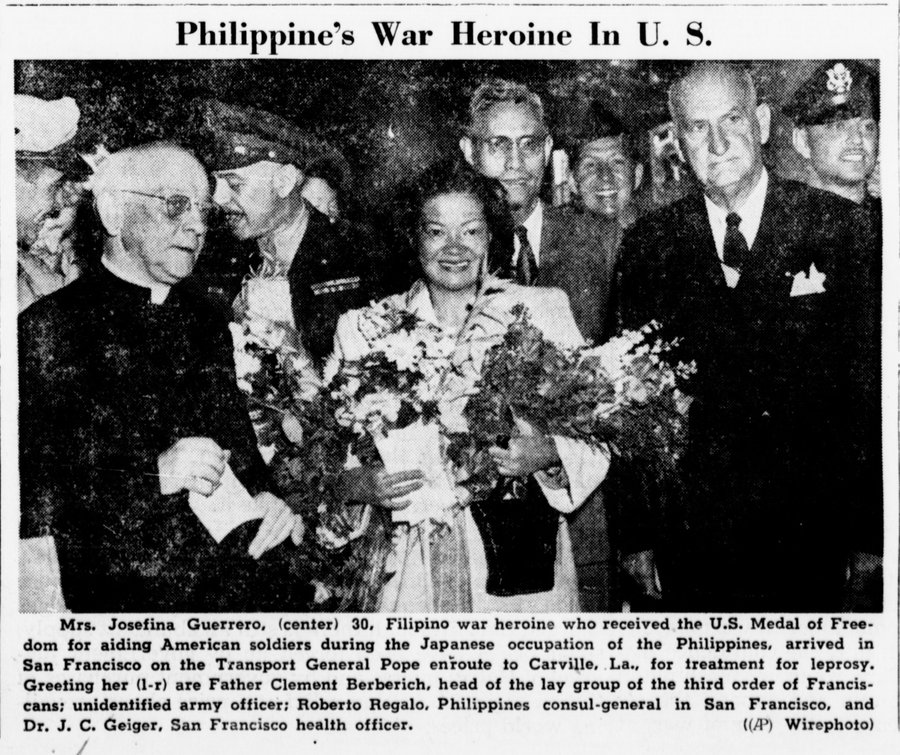
Less than two weeks after the ceremony, Clark granted special permission for Guerrero to sail to the U.S. She was greeted with great fanfare in San Francisco, by a crowd that included “soldiers who knew her as ‘Joey’ when she smuggled food through Japanese lines to them in prison, carried messages, and drew charts of Japanese gun emplacements and minefields,” according to newspaper accounts.
Guerrero’s arrival coincided with a push by patients and prominent advocates to destigmatize Hansen’s disease, placing her in the role of “cause célèbre,” says Montgomery. The condition was “getting a lot of attention when she shows up, and her presence just accelerates that.”
On August 20, 1951, the waiver allowing Guerrero to stay in the country expired, triggering a 13-year period of uncertainty. An array of advocates—legal associations, veterans’ groups, women’s clubs and congresspeople who had introduced bills on her behalf—rallied to her cause. The treatment Guerrero had dreamed of took longer than expected; she remained at Carville until 1957. On August 5, 1964, Guerrero was granted permanent residence, paving the way for her eventual citizenship.
It was after this long-sought relief that Guerrero, the spy who had concealed her exploits during the war but was thrust into the role of public hero after the conflict’s end, began to lead a more obscure peacetime life.
Beginning in 1977, Guerrero lived quietly in Washington, D.C., maintaining a circle of friends who knew little of her past. She spent time in the Peace Corps, worked as a secretary and volunteered as an usher at the Kennedy Center. Her 1996 obituary states that she was born in Manila but makes no mention of her wartime heroism.
Throughout a lifetime filled with hardship and loss, Guerrero found a way to hide what she didn’t want known and to quietly bear the things that caused her grief. In the worst moments of the war, she proved that valor does not belong only to the strong: Sick and suffering, Guerrero mustered courage that protected the lives of soldiers headed into one of the fiercest battles of World War II.
ARCHIVE:
Captain Nieves Fernandez: The only known Filipino female guerilla leader